SEO
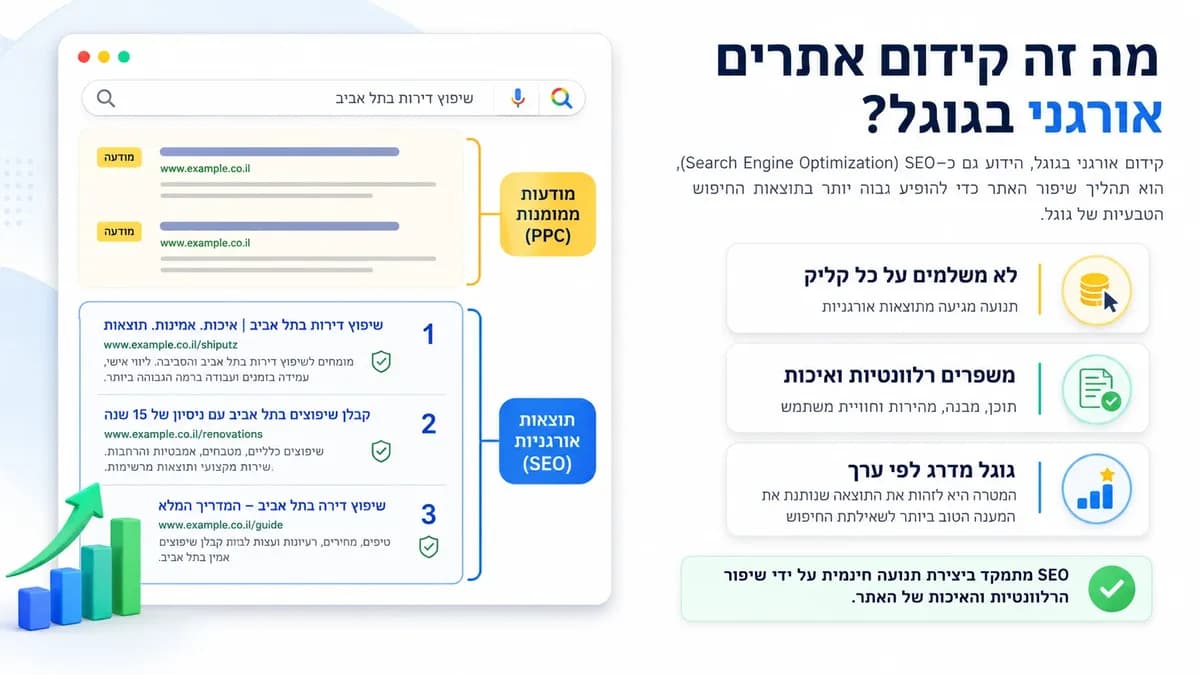
Organic SEO (search engine optimization) is the process of improving your website, its content, and its technical structure in order to increase its visibility in Google's organic search results and in advanced search experiences such as rich results and AI-based answers, for relevant queries.
An organic SEO service is the process of improving your website's content, technical structure, authority, and measurement in order to increase visibility in Google's organic search results, attract relevant traffic, and turn it into inquiries, purchases, or business opportunities. Modern SEO includes search-intent research, technical SEO, expert content, internal linking, digital authority, rich-result readiness, local search, eCommerce, AI Search, and business measurement. It does not promise a specific position; it builds a measurable foundation for organic growth over time.
2026
SEO used to be measured mostly by your position for a specific phrase. Today that is just the starting point: users ask in natural language, compare vendors, and expect a clear answer before they ever leave their details. Google Search itself blends organic results, ads, maps, video, product listings, rich results, and AI features.
The meaning for your business is simple: it is not enough to show up with a generic service page. You need to build an organic asset that search engines can crawl and understand, that users can read and make a decision from, and that measurement systems can connect to a business outcome.
| Old SEO | Modern SEO |
|---|---|
| Focusing on short keywords | Mapping search intents, customer questions, and the full buying journey |
| Generic blog articles | Service pages, comparisons, buying guides, FAQ, case studies, and expert content |
| Rank checking only | Measuring impressions, clicks, CTR, conversions, SQLs, pipeline, purchases, and CPA |
| Link building by quantity | Building authority through reputation, partnerships, quotable content, and brand mentions |
| SEO as a separate channel | SEO connected to Google Ads, CRM, content, GEO/AEO, automation, and sales |
Infrastructure
Despite the changes in search results, SEO has not disappeared. On the contrary — it has become an even more fundamental layer of infrastructure. For a website to appear on Google, in rich results, in local search, in product results, in AI Overviews, or in search journeys that continue into AI engines, it must be clear, accessible, indexed, fast, helpful, and measurable. Good SEO helps Google understand what you offer, which questions you are relevant for, who the service fits, what proof you have, and how the pages on your site connect to each other. It also helps users make a decision. SEO is not free traffic: there is no payment to Google per organic click, but there is an investment in strategy, content, technology, measurement, and continuous improvement. The advantage is that this investment builds an organic asset that can reduce dependence on paid media over time, when it is managed correctly.
The Service
A professional SEO service should start from the business, not the keyword. Before writing content or fixing tags, we need to understand what you sell, who the customers are, what counts as a quality lead, where the profitability is, which queries bring customers, and how success is measured after the user leaves their details.
We run a deep audit of the site, the content, and your current visibility. The audit separates critical issues, quick opportunities, and long-term growth moves.
Keyword research is only part of the work. We build a search-intent map that connects your customers' questions to the pages that should appear for them.
Even excellent content will not work if Google cannot crawl, understand, index, and render it correctly. That is why technical SEO is an inseparable part of the service.
We do not write more articles just to make the site bigger. We build content assets that explain, compare, answer, prove, and lead to action.
Authority is not built from a monthly link quota. It is built from the combination of a clear brand, quality content, relevant mentions, real partnerships, reviews, business profiles, strong internal links, and assets people genuinely want to cite or share.
A good SEO report does not end at rankings. We build measurement that shows what is truly progressing and what creates business value.
AI Search
SEO and GEO/AEO need to work together, but they are not the same service. SEO builds the organic foundation: indexing, site structure, content, internal links, user experience, authority, and measurement. GEO/AEO adds a visibility layer focused on answers, citations, entities, and AI engines. Within our SEO services we build the base that can later be extended into AI-engine visibility: clear pages, answer-oriented content, valid schema, accessible text, internal links, up-to-date information, and business measurement. Our principle: we do not sell a magic file, we do not promise to appear in every AI answer, and we do not use technical jargon to create an illusion. We build a search foundation that is clear, expert, accessible, and measurable.
Fit
SEO fits businesses that already have search demand or the potential to build demand through professional content. It is a weaker fit for anyone looking for an instant-only fix, or who cannot invest in improving the site and its content over time.
In complex sales processes, customers do not decide after one click. They ask, compare, read, vet vendors, and look for proof. SEO builds visibility around the problems, questions, and criteria that lead to a meeting or an SQL.
For startups, SEO can build category authority, explain a new problem, support Go-to-Market, and strengthen visibility in a global market. The work needs to be flexible, measurable, and connected to changes in product, audience, and messaging.
Lawyers, doctors, consultants, clinics, service companies, and local providers need to show up when a customer searches for a service in their area or compares providers. Here SEO combines service pages, Google Business Profile, reviews, service areas, and content that makes expertise obvious.
In an online store, SEO affects categories, products, buying guides, comparison questions, product information, Product schema, Merchant Center, and the purchase experience. The goal is not just sessions, but purchases, revenue, ROAS, and CPA.
Google Ads data can reveal which queries actually bring leads, purchases, or SQLs. When you connect Paid Search to SEO, converting queries can be turned into organic content assets — reducing media dependence over time.
Transparency
Transparency also means saying when SEO is not the right solution.
Comparison
The right choice depends on the business stage, the goals, the level of competition, and the ability to measure a business outcome. In most cases the answer is not a single channel, but the right combination of organic search, paid advertising, content, CRM, and sometimes GEO/AEO too.
| Business situation | What fits better | Why |
|---|---|---|
| You need leads or purchases in the short term | Google Ads or Paid Search | Lets you test messages, queries, and landing pages quickly. |
| You want to reduce dependence on media budgets over time | SEO | Builds organic assets that can keep bringing traffic and conversions over time. |
| You have SEO in place and want visibility in AI answers too | GEO/AEO | Extends the organic foundation into the world of answers, citations, and entities. |
| You have a long B2B sales process | SEO, GEO/AEO, LinkedIn, ABM, and CRM | Enables presence across the comparison, learning, and decision stages. |
| You have good data from paid campaigns | SEO and PPC together | Use converting queries to build stronger organic pages. |
| The goal is CPA, not just CPL | SEO, Paid, CRM, and automation | Connect the traffic source to lead quality, sales stages, and the business outcome. |
Specialization
For local businesses, Google search is often the most important touchpoint before an inquiry. For online stores, SEO directly affects categories, products, and sales.
For local businesses, Google search is often the most important touchpoint before an inquiry. Customers look for a nearby service, check ratings, read reviews, look at opening hours, and compare providers.
eCommerce sites need different SEO than service pages. Here we handle category structure, product pages, filters, thin content, duplication, stock availability, price, images, buying guides, and purchase measurement.
How We Work
Professional SEO is an organized process. It starts with an audit, continues with prioritization, moves into ongoing execution, and is measured by business impact.
We understand what you sell, who the target audience is, what a quality lead is, and which metrics should lead the work.
We learn what you sell, who the target audience is, what a quality lead and a profitable customer look like, which services matter more, and which metrics should lead the work.
A review of the site, Search Console, GA4, technical structure, internal links, content, competition, and gaps.
We review the site, Search Console, GA4, existing pages, technical structure, internal links, content, competition, and gaps. The deliverable is a clear status picture, not a generic task list.
We identify what must be fixed now, which pages to upgrade, which content assets are missing, and what can create fast impact.
We identify what must be fixed immediately, which pages are worth upgrading, which content assets are missing, and which opportunities can create relatively fast impact.
A practical work plan: what gets fixed, what gets written, what gets improved, who is responsible, what depends on development, and what is measured.
We build a practical work plan that defines what gets fixed, what gets written, what gets improved, who is responsible, what depends on development, and what is measured at the end of the period.
We implement technical fixes, upgrade pages, create content, strengthen internal links, and build authority.
We implement technical fixes, upgrade existing pages, create new content assets, strengthen internal links, build authority, and update the site based on data.
Every month we check what changed in visibility, traffic, conversions, and lead quality, and prioritize the next month.
Every month we check what changed in visibility, traffic, conversions, and lead quality. We identify what worked, what got stuck, what needs a refresh, and what should be prioritized next month.
Once a solid SEO foundation exists, the work can extend into a GEO/AEO layer.
Once a solid SEO foundation exists, the work can extend into a GEO/AEO layer: answers, citations, entities, AI-engine visibility checks, and content assets built for new search journeys.
The cost of SEO depends on the state of the site, its size, the level of competition, language, target market, page count, the depth of technical work, the scope of content, the need for business measurement, and whether a CRM or sales-system connection is required. We do not build packages around a fixed number of links or articles, but around the site's maturity stage and the business challenge.
Best for: businesses that want to understand where the site stands and what needs to happen before committing to a monthly process.
Best for: sites that need a basic organic foundation, technical fixes, and upgrades to core service pages.
Best for: businesses that want continuous organic growth around content, service pages, commercial questions, and measurement.
Best for: companies in competitive markets — B2B, SaaS, professional services, and fields where the customer's decision requires trust and expertise.
Best for: online stores that want to strengthen categories, products, buying guides, and organic sales.
Best for: companies that already have an SEO base and want to extend visibility into the world of answers, citations, and AI engines.
Why Via Marketing
We connect content and queries to leads, SQLs, pipeline, and CPA.
Organic traffic is an important metric, but it is not the end goal. We want to understand which content brings quality leads, which queries generate SQLs, which pages influence pipeline, and where CPA can come down.
SEO connects to Google Ads, Meta Ads, LinkedIn Ads, Email Marketing, MarTech, CRM, websites, Fractional CMO, and ABM.
SEO does not operate in a vacuum. This connection turns campaign data into organic content assets, and turns organic traffic into measurable business opportunities.
No professional provider can control Google or guarantee a #1 ranking.
What we do build is a professional, transparent, measurable process: audit, prioritization, fixes, content, measurement, and continuous improvement.
We build real authority through content, mentions, partnerships, and Digital PR.
Artificial links and bulk link buying can put a site at risk. Instead, we build real authority through quality content, mentions, partnerships, business profiles, Digital PR, and relevant relationships.
Good SEO content should be clear to a marketing manager, a CEO, a sales manager, a product manager, or an end customer.
It has to answer questions, explain a process, show fit, present proof, and lead to action.
Structured, measurable, accessible, clear pages are good for SEO, for users, and for extending into GEO/AEO.
The pages we build need to be structured, measurable, accessible, and clear. That is good for SEO, good for users, and good when you later want to extend the work into GEO/AEO.
Proof
We only show data here that can be backed internally. There are no percentages, revenue figures, SQLs, CPA, ROAS, or pipeline claims without a verified number behind them. This is what a case card looks like with us.
Our results
No vague rankings. Quality traffic, leads that close, and ROI connected to real numbers — on average across our clients, after 12 months of work.
The average our clients see. Continuous growth, without increasing the advertising budget.
Most clients reach positions 1–3 for their core phrases — where most of the clicks are — within 6–9 months.
Not just traffic — leads with purchase intent. The close rate of organic leads is 14.6% higher than paid.
A significant share of quality leads comes from organic search, not from paid.
An organic lead costs on average about a third of a lead from paid advertising — and the cost only drops over time.
The third year of SEO usually returns 7–10 times the cumulative investment. An asset that keeps producing over time.
Leave your details and we'll run an initial SEO audit.

Optimize content for LLMs (GEO): answer-first structure, schema, citations, internal links, and freshness for AI Overviews, ChatGPT & Gemini
Rank your SaaS higher on Google in 2025 with proven SEO strategies, keyword research, content, technical SEO, & backlinks for organic growth.