B2B Buyer Persona: A Comprehensive Guide to Aligning Marketing & Sales
Learn step-by-step how to create a B2B buyer persona and align marketing and sales strategies, including examples, templates, and expert tips
Via Marketing


Learn step-by-step how to create a B2B buyer persona and align marketing and sales strategies, including examples, templates, and expert tips
Creating detailed B2B buyer personas is essential for aligning marketing and sales efforts with the right audience. Research shows that “knowing your B2B buyer persona is key to making informed sales and marketing decisions,” and many companies are prioritizing persona development to guide their strategy.
In a B2B context, buyer personas are semi-fictional profiles of the key decision-makers and influencers within target companies. These personas include firmographic data (company size, industry, revenue) and individual traits (role, goals, pain points) that shape how buying decisions are made. By understanding these profiles, marketing teams can craft targeted content and campaigns that directly address the needs of each role. For example, a persona might reveal that Tech-Savvy Tom , a CTO at a mid-sized software company, values technical demos and data-driven ROI analysis over generic sales pitches. Building such detailed personas ensures your messaging resonates with the right people. Moreover, targeting the wrong prospects can be expensive. Developing “ negative personas” (profiles of unqualified or uninterested buyers) helps teams focus on productive leads and avoid wasted effort. With well-defined B2B buyer personas, companies can improve lead quality, close deals faster, and increase revenue.
A B2B buyer persona is a semi-fictional representation of an ideal customer in a business context. It typically describes a decision-maker or influencer in an organization, focusing on their role, responsibilities, goals, and challenges. For example, a persona might outline a purchasing manager in a healthcare tech firm, noting their budget constraints, compliance concerns, and preference for data-rich case studies. B2B personas go beyond demographics to include firmographics (industry, company size, location), job roles, and buying criteria. These profiles help businesses understand who they are selling to and tailor their approach accordingly. In practice, creating a persona involves gathering data from customer interviews, CRM records, and market research to capture both quantifiable details (like company revenue) and qualitative insights (like personal motivations). This comprehensive view enables more precise targeting: companies with strong buyer personas report better alignment of marketing and sales efforts, higher conversion rates, and improved customer relationships.
B2B buyer personas differ significantly from B2C personas. A B2B persona represents a business professional making decisions on behalf of a company, whereas a B2C persona profiles an individual consumer. B2B purchases are typically rational and team-driven : decision-makers carefully evaluate ROI, scalability, and long-term benefits. They often involve multiple stakeholders (e.g., engineering, procurement, finance) and longer sales cycles. In contrast, B2C personas focus on personal demographics and emotional drivers (e.g., lifestyle, personal values).
For instance, a B2C campaign might appeal to a consumer’s desire for convenience or status, but a B2B campaign must address specific business challenges and regulatory requirements. Research notes that B2B personas “think strategically and act on behalf of their company, but they are also people who have personal goals and needs”. In other words, B2B personas require messaging that balances company-level benefits (efficiency, cost savings) with individual-level motivations (career success, risk aversion). Recognizing these differences ensures your marketing content and channels are chosen appropriately; weighing SEO vs PPC is a prime example of channel choice that varies by persona.
Effective B2B buyer personas combine several key components:

By compiling these elements, you can create a 360° profile of each buyer type. For example:
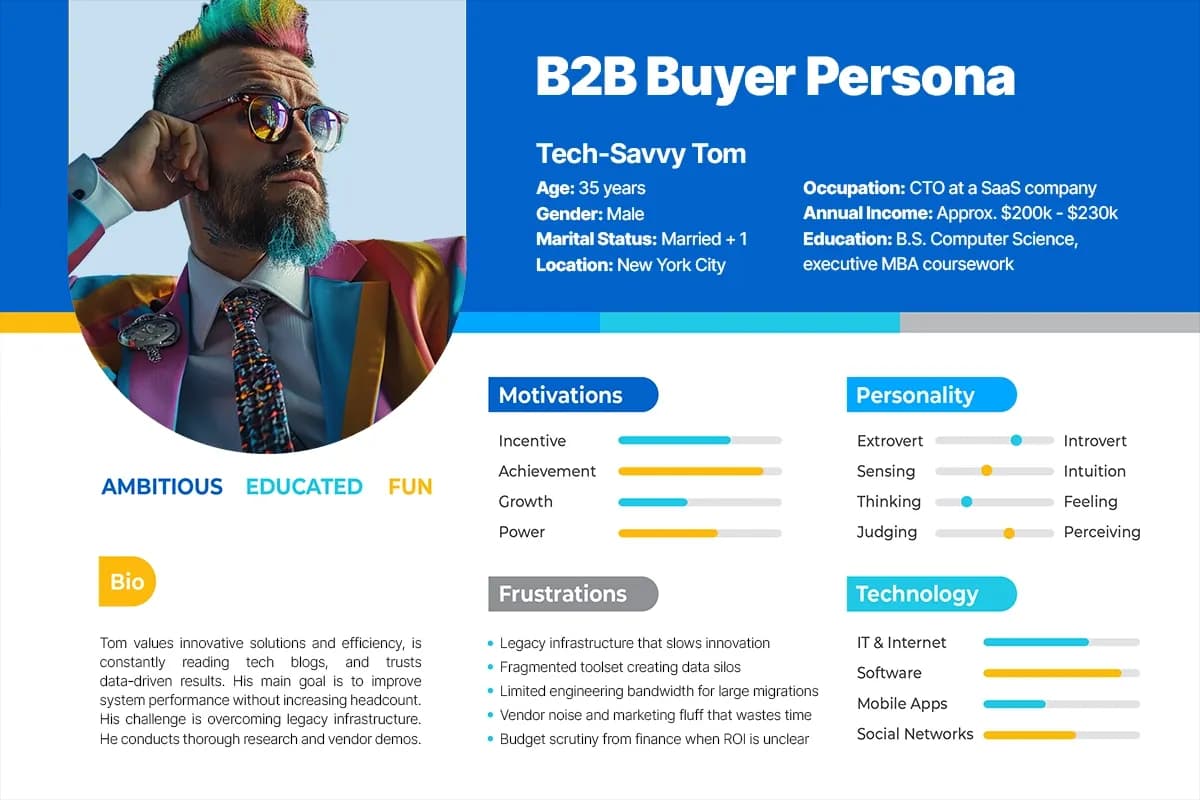
Persona sheets often include a photo or name (“Tech-Savvy Tom”) to humanize the data. By referring to “Tom” in marketing copy and sales conversations, teams align on a concrete image of the buyer. This example underscores how B2B personas capture both company factors and individual nuances.
Developing a B2B buyer persona is a structured process. Follow these steps to build accurate, actionable personas:

By following these steps, your team develops B2B buyer personas grounded in data and real-world insights. The resulting personas become the blueprint for targeted marketing, ensuring every campaign message resonates with the right decision-makers.
Well-crafted buyer personas should guide all aspects of your B2B strategy. Below are key ways to implement personas in marketing, sales, and lead generation:

Adapting your strategy around personas creates consistent experiences: marketing messaging, sales conversations, and customer service all “speak the same language.” This alignment not only boosts efficiency but also builds trust with prospects, as every interaction reinforces that you understand their unique situation.
Creating personas is not a one-time effort. Markets evolve, technologies change, and new data becomes available. To keep personas effective:

By regularly reviewing persona effectiveness and industry changes, companies ensure their personas remain accurate guides. An up-to-date persona strategy prevents wasted budget on irrelevant leads and empowers teams to make decisions with confidence.
Beyond basic personas, advanced strategies such as product differentiation can yield a competitive edge:

Negative (exclusionary) personas define who not to target. These are profiles of prospects unlikely to convert, such as those with no budget, outside your target industry, or whose needs don’t align with your offerings. Identifying these personas helps refine marketing by excluding them from campaigns. For example, if a company repeatedly sees inquiries from a certain sector that never become customers, it can create a negative persona and block that segment from lead ads. Research notes that negative personas represent individuals unlikely to convert or engage . By focusing only on positive-fit personas, businesses improve ROI and save resources. Building a negative persona involves analyzing lost deals or unqualified leads to spot common traits, then adjusting targeting criteria accordingly.
In B2B marketing, industry influencers and thought leaders play a growing role. Partnering with respected figures (e.g., a well-known IT analyst or a popular tech podcast host) can amplify your brand’s credibility among target personas. Influencers can help you reach niche audiences and add authenticity: 67% of B2B brands use influencer marketing to increase brand awareness, and 54% leverage it to boost credibility and trust. For example, co-creating a webinar with an industry expert can attract their followers while validating your message. When selecting influencers, ensure they resonate with your personas’ interests and values. Collaborations might include joint content, speaking events, or endorsements. Incorporating influencer insights into persona content also helps by aligning messaging with topics the target audience respects.
Artificial intelligence is revolutionizing persona development. AI tools can analyze massive datasets from website behavior and purchase history to social interactions to uncover hidden persona segments and preferences. Unlike static personas built on assumptions, AI-driven personas evolve with new data. For example, machine learning can reveal that a subset of your audience regularly compares prices on your site, prompting a “bargain-seeker” persona. AI can also personalize content in real time: platforms exist that use AI personas to automate messaging adjustments based on user behavior. McKinsey reports that personalized experiences driven by AI can increase revenue by up to 15%. By leveraging AI, marketers create dynamic personas that reflect current customer trends, enabling ever-more precise targeting and higher engagement.
These advanced techniques include negative personas to cut waste, influencers to build trust, and AI to continuously refine insights, extending the value of personas beyond traditional segmentation. Together, they ensure B2B companies stay agile and targeted in an increasingly complex market.

A B2B buyer persona is a semi-fictional profile of an ideal customer’s role and characteristics in a business setting. It includes details like job title, company size, goals, and pain points. Personas are important because they help marketers and sales teams tailor messaging and strategy to real customer needs, improving engagement and conversion.
Start by defining who you want to target and gathering data. Use market research, website analytics, surveys, and especially interviews with real customers and sales reps. Identify common traits and motivations from this data. Create a persona document with sections for firmographics, goals, challenges, and buying criteria. Finally, validate and refine the persona with team feedback and performance metrics.
An ICP describes the perfect type of company (account) for your offering, focusing on firmographics like industry, company size, and revenue. A B2B buyer persona describes the people within those companies (their roles, needs, and preferences). In practice, you might use your ICP to identify target accounts, then use buyer personas to guide how you engage individuals at those accounts.
Negative personas (exclusionary personas) are profiles of unqualified or disinterested customers you want to avoid. Examples include companies that can’t afford your product or lead queries that don’t match your ICP. By defining these, you can exclude them from marketing campaigns, save on the budget, and focus on leads that are more likely to convert.
AI can analyze large datasets (customer behavior, social data, etc.) to dynamically refine personas and uncover insights humans might miss. AI-driven personas adapt in real time as new data comes in, ensuring they stay accurate. For example, AI can identify emergent buyer segments or preferences, and personalized AI models can tailor content delivery for different personas. This leads to smarter targeting and better ROI.

In the B2B data-driven world, buyer personas are the cornerstone of focused marketing. They bridge the gap between generic campaigns and the specific needs of real buyers, enabling personalized engagement that drives results. By following a structured development process from research and segmentation to continuous refinement, companies ensure their personas remain relevant.
Advanced tactics like negative persona exclusion, influencer partnerships, and AI-powered analysis further sharpen this toolset. Ultimately, a robust persona strategy aligns marketing, sales, and product teams around a clear vision of the ideal customer. As markets and technologies change, regularly revisiting and updating your personas will keep your messaging effective. For B2B organizations without in-house expertise, seeking help through fractional CMO services can accelerate persona creation and integration. Alternatively, you can hire a fractional CMO to accelerate your B2B growth without the overhead of a full-time executive. With the right personas, businesses attract high-quality leads, boost conversion rates, and make every marketing dollar count.